


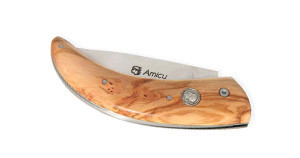
How Does a Folding Knife Mechanism Work?
Folding knives are used by millions of people every day, whether carried in a pocket, used at the table or taken on outdoor adventures. Behind their apparently simple design lies a precise mechanical system developed through centuries of cutlery craftsmanship.
From traditional laguiole pocket knives to modern locking knives, understanding how these mechanisms work will help you choose the right model, handle it safely and maintain it properly.
This guide explains the main components, opening methods and blade locking systems found in folding knives.
The Anatomy of a Folding Knife: Understanding Its Components
Unlike a fixed-blade knife, a folding knife features a blade that rotates around a pivot and folds into the handle.
Its construction involves two main elements: the blade and the handle.
The Blade
The blade consists of several important parts:
- Cutting edge: the sharpened section used for cutting.
- Tip: the pointed end of the blade.
- Spine: the unsharpened back of the blade.
- Grind: the tapered surfaces leading towards the cutting edge.
- Tang: the base of the blade that connects to the pivot mechanism.
Many traditional pocket knives also feature a nail nick, a small groove that allows the user to open the blade with a fingernail.
The Handle
The handle is built around metal liners, which provide structural strength and support the mechanism.
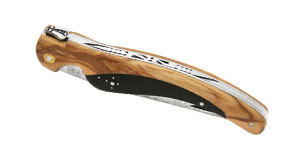
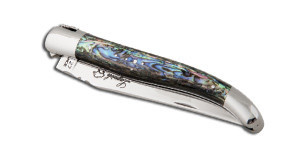
Handle scales made from wood, horn, bone or modern composite materials are fitted to these liners, providing comfort and an attractive finish.
At the centre of many traditional folding knife mechanisms is the backspring, a steel component positioned along the spine of the handle. It provides resistance when the blade is opened or closed.
The pivot pin allows the blade to rotate between its open and closed positions.
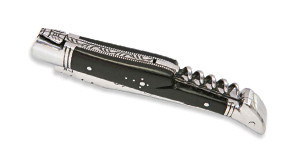
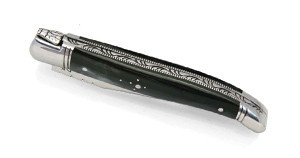
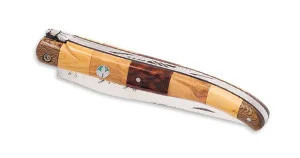
On a traditional laguiole knife, several additional components are particularly distinctive:
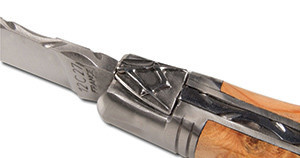
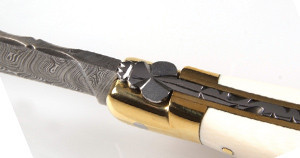
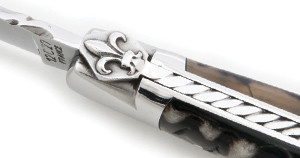
- The bee or fly: the decorative metal feature at the end of the spring, often shaped like a bee.
- Bolsters: metal fittings at the ends of the handle.
- Blade stop: a feature designed to prevent the cutting edge from striking the spring when the knife closes.
Together, these components create a mechanism that combines mechanical precision with traditional French craftsmanship.
.png)
How Does a Folding Knife Open?
Folding knives use several opening systems, ranging from traditional manual mechanisms to modern one-handed designs.
Nail Nick Opening
This is one of the most common opening methods on traditional French pocket knives.
A small groove in the blade allows the user to grip it with a fingernail and pull it out of the handle.
Simple, durable and reliable, this system is found on most traditional laguiole folding knives.
The Two-Pin Mechanism
Some early folding knives used an extremely simple construction.
One pin acted as the blade pivot, while another served as a stop when the blade was opened.
This straightforward mechanism illustrates the simplicity of traditional knife construction.
Thumb Opening
Many modern folding knives can be opened with one hand.
They may feature a thumb hole, popularised by Spyderco, or a thumb stud attached to the blade.
By applying pressure with the thumb, the user can rotate the blade into its open position.
This practical system is particularly popular on everyday carry knives, commonly known as EDC knives.
Flipper Opening
A flipper is a small protrusion extending from the blade when the knife is closed.
Pressing it with the index finger rotates the blade towards its open position.
Depending on the knife's design, the blade may then engage a locking mechanism.
Spring Mechanisms and Slip Joints
On traditional spring-operated knives, a spring applies pressure to the blade tang.
This pressure helps hold the blade in its open or closed position.
The user must overcome the spring's resistance to move the blade.
A traditional slip joint mechanism provides resistance but does not positively lock the blade open.
Assisted Opening
An assisted-opening knife uses a spring mechanism to help deploy the blade.
Once the user begins opening the blade manually, the spring assists the remaining movement.
This allows the blade to open quickly with relatively little effort.
Not all folding knives make the same clicking sound when opened. On knives equipped with a positive locking system, an audible click may indicate that the lock has engaged, but the mechanism should always be checked before use.
Folding Knife Blade Locking Systems
A locking mechanism is designed to prevent the blade from closing unintentionally during use.
Different knives use different systems, each offering particular advantages.
Friction Folder: No Mechanical Lock
A friction folder does not have a dedicated blade locking mechanism.
Instead, friction around the pivot helps maintain the blade's position.
Some designs also feature an extended tang that the user holds with their thumb to help keep the blade open.
This principle can be found on certain traditional knives, including Japanese Higonokami knives.
Because the blade is not positively locked, particular care is required during use.
Slip Joint Mechanism
The slip joint is one of the most traditional folding knife mechanisms.
A backspring applies constant pressure to the blade tang, helping maintain the blade in the open or closed position.
To close the knife, the user must overcome the resistance of the spring.
This system is widely used on traditional French regional pocket knives, including many laguiole models.
Its main advantages are simplicity, reliability and a relatively small number of components.
However, a slip joint is not a true locking mechanism: sufficient force on the blade can cause it to close.
Rotating Collar Lock: The Opinel System
The rotating collar is a particularly well-known locking mechanism.
A slotted metal ring surrounds the handle near the pivot.
Once the blade is opened, the user rotates the ring to prevent the blade from closing.
On many modern Opinel knives, the collar can also secure the blade in its closed position.
This mechanism is appreciated for its simplicity, durability and ease of use.
Liner Lock
The liner lock is one of the most common locking systems on modern folding knives.
One of the metal liners inside the handle is cut and shaped to act as a spring.
When the blade opens, this spring section moves behind the blade tang, preventing the blade from folding.
To close the knife, the user pushes the liner sideways to disengage the lock before folding the blade.
This system is compact and allows convenient one-handed operation.
Frame Lock
The frame lock works on a principle similar to the liner lock.
However, instead of using a separate internal liner, part of the handle frame itself acts as the locking element.
Because this component can be relatively thick, the mechanism is often designed to provide substantial strength.
Frame locks are commonly found on premium modern EDC knives.
Back Lock
The back lock, also called a lockback, uses a locking bar positioned along the spine of the handle.
When the blade opens, part of this bar engages a notch in the blade tang.
This prevents the blade from closing until the locking bar is deliberately released.
Pressing the release section of the bar disengages the mechanism, allowing the blade to fold.
Back locks are valued for their reliability and are used by several major knife manufacturers.
Axis-Style Lock
An axis-style lock uses a transverse locking bar that moves within slots in the handle.
Springs push the bar into position behind the blade tang when the knife is opened.
To release the blade, the user pulls the locking bar backwards.
This mechanism is appreciated for its smooth operation and ambidextrous design.
Button Lock
A button lock uses an internal locking component operated by a push button.
Pressing the button releases the blade, allowing it to fold.
The system is particularly convenient on knives designed for quick, one-handed operation.
.png)
How to Open and Close a Folding Knife Safely
Proper handling is essential to using a folding knife safely.
Opening Your Folding Knife
Hold the handle firmly while keeping your fingers away from the blade's path.
Depending on the mechanism, use the nail nick, thumb stud, thumb hole or flipper to open the blade.
Guide the blade into its fully open position.
If your knife has a locking mechanism, check that the lock has engaged correctly before using it.
Remember that traditional laguiole slip joint knives do not necessarily have a positive blade lock.
Closing Your Folding Knife
Before closing a locking knife, release its locking mechanism.
Keep your fingers away from the space into which the blade folds.
For a liner lock or frame lock, move the locking component sideways and carefully guide the blade into the handle.
For a slip joint knife, overcome the spring resistance while maintaining full control of the blade.
Never allow the blade to snap shut uncontrolled.
Four Mistakes to Avoid
- Trying to close a locked blade without releasing its locking mechanism.
- Placing your fingers in the blade's closing path.
- Allowing a spring-operated blade to snap shut suddenly.
- Assuming that a friction folder or slip joint is positively locked when it is not.
Careful handling protects both the user and the knife mechanism.
Traditional vs Modern Folding Knife Mechanisms: What Are the Differences?
Folding knife mechanisms can generally be divided into two broad categories.
Traditional Mechanisms
Traditional systems include friction folders, slip joints and rotating collar locks.
Their main advantages are simplicity, durability and ease of maintenance.
With relatively few moving components, they can provide many years of reliable service.
These mechanisms are characteristic of traditional French cutlery, including laguiole knives, Opinel knives and other regional pocket knives.
They often require two-handed opening and prioritise straightforward construction over rapid deployment.
Modern Mechanisms
Modern mechanisms include liner locks, frame locks, axis-style locks and one-handed opening systems.
They are generally designed to provide quick access to the blade and a positive locking function.
These features are particularly popular on contemporary EDC knives.
However, more complex mechanisms may contain additional moving parts that require cleaning and maintenance.
The choice between traditional and modern mechanisms therefore depends largely on the intended use of the knife.
How to Choose a Folding Knife Based on Its Mechanism
The ideal folding knife is the one that best suits your needs.
For Everyday Use
If you regularly open parcels, cut string or use a knife for outdoor activities, a folding knife with a convenient opening system and a reliable lock may be a practical choice.
Liner locks and frame locks are commonly used for this purpose.
For Dining and Traditional Use
A traditional laguiole knife with a slip joint mechanism combines elegant design with the heritage of French cutlery.
Its spring mechanism is particularly well suited to the traditional character of the knife.
For Collectors and Gifts
For a collector or someone looking for a special gift, the mechanism is only one consideration.
The quality of the finish, handle materials, spring decoration and craftsmanship may be equally important.
A finely made laguiole knife brings together traditional mechanics, attractive materials and distinctive design.
Whatever your choice, a well-made knife with a properly adjusted mechanism and a quality steel blade can provide many years of service.
A Well-Designed Mechanism for a Long-Lasting Knife
The operation of a folding knife depends on three essential functions:
- Opening: using a nail nick, thumb stud, thumb hole, flipper or assisted mechanism.
- Blade retention or locking: from the traditional slip joint to modern positive locking systems.
- Safe closing: allowing the blade to return into the handle in a controlled manner.
Understanding these mechanisms makes it easier to choose, use and maintain a folding knife.
Whether you prefer the timeless character of a traditional laguiole knife or the practical features of a modern EDC model, the quality of the mechanism plays an essential role in the knife's performance, reliability and durability.